Jensen Huang, NVIDIA RTX Spark, and Microduck: Why AI Agents Training Robots Matters More Than Casual Chat
At NVIDIA GTC Berlin 2026, CEO Jensen Huang demonstrated four bipedal Microduck robots created by Pollen Robotics (Hugging Face). Beyond the entertaining physical antics, the true technical milestone lies in the sim-to-real workflow: how AI agents on NVIDIA RTX Spark orchestrate Isaac Sim digital twins, cloud reinforcement learning, and deploy neural motion policies directly onto an embedded Rockchip RK3566 processor.
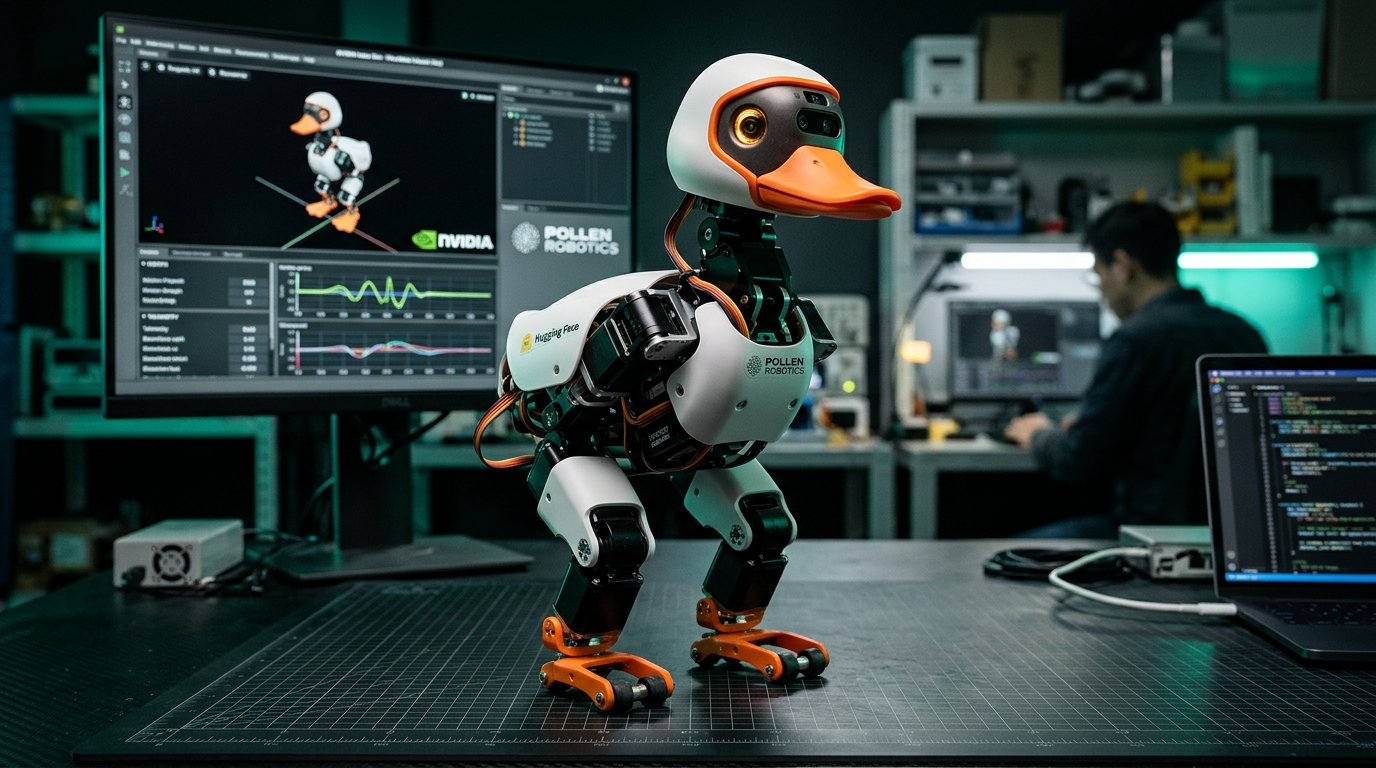
During the opening keynote of NVIDIA GTC Berlin held at the Tempodrom on October 21, 2026, NVIDIA CEO Jensen Huang unveiled a charismatic stage demonstration: four miniature bipedal duck-shaped robots dubbed Microduck. In front of an audience of engineers and enterprise technologists, the small two-legged robots executed calibrated physical maneuvers—sitting, standing upright, dynamic balancing, and tucking into a resting sleep pose.
Across social media and mainstream commentary, the scene was quickly sensationalized as Jensen Huang 'casually chatting with intelligent duck robots'. However, for robotics engineers and machine learning practitioners, the substance of NVIDIA's demonstration revealed something far more consequential: an end-to-end demonstration of Physical AI and simulation-to-reality (sim-to-real) transfer, orchestrated semi-autonomously by local AI agents.
Separating Keynote Demonstration from Sci-Fi Hype
To accurately assess the technical boundaries of what was shown, engineers must anchor their analysis in official NVIDIA and Pollen Robotics documentation rather than anthropomorphic theatrics:
- Keynote Reality: Jensen Huang spoke toward the robots on stage. However, official technical notes do not substantiate an open-ended conversational large language model controlling the robot's real-time physical actions. The robots responded to structured command cues that triggered pre-trained reinforcement learning locomotion policies.
- Not an NVIDIA-Exclusive Product: Microduck is a bipedal robotics platform engineered by Pollen Robotics, a robotics research team under Hugging Face. NVIDIA utilized the physical platform as a real-world proof-of-concept for its compute ecosystem and simulation software stack.
- Not Learning From Scratch On Stage: The robots did not learn how to walk or balance live during the keynote. Their bipedal locomotion policies were pre-trained through millions of simulated physics steps in the cloud prior to the event.
Microduck Hardware Anatomy: A Compact Bipedal Physical AI Testbed
Unlike Pollen Robotics' previous desktop-bound robotic systems like Reachy Mini, which emphasized expressive human interaction and table-top arms, Microduck was purposely built as an accessible platform for researching locomotion, dynamic balance, and sim-to-real policy deployment on two legs:
- Dimensions & Form Factor: Stands approximately 25 centimeters tall with a total weight under 800 grams, ensuring safe laboratory experimentation without risks of mechanical destruction.
- Dynamic Actuation: Equipped with 15 dynamic servo motors offering 15 degrees of freedom (DoF), driving multi-axis articulation across the neck, hips, knees, ankles, and a motorized beak capable of grasping small objects.
- Integrated Sensor Suite: High-resolution front camera, an 8x8 Time-of-Flight (ToF) LiDAR array for obstacle depth sensing, and dual independent 6-axis IMUs (Inertial Measurement Units) for high-frequency orientation and acceleration telemetry.
- Embedded Edge Compute: Powered by an onboard Rockchip RK3566 SoC featuring an integrated AI NPU accelerator, 1 GB of RAM, and 32 GB eMMC storage running a dedicated Linux kernel.
- Control & Connectivity: Wi-Fi and Bluetooth wireless connectivity, microphone, speaker, and a high-frequency local control loop operating at roughly 50 Hz.
- Research Accessibility: Available on pre-order at an introductory price of US$399. The software stack (firmware, kinematics, and Rust-based locomotion control) is open-source on GitHub, while the mechanical molds and hardware schematics remain commercial.
The Three-Tier Architecture: RTX Spark, Cloud Compute, and Onboard Edge
A frequent technical misconception is assuming that NVIDIA's RTX Spark AI computer is housed inside the Microduck chassis. In reality, modern physical AI systems employ a modular, three-tier workload distribution:
- Tier 1: Local Agent Orchestration (NVIDIA RTX Spark): Acts as the developer's engineering cockpit. RTX Spark is a Windows-based local AI PC platform offering up to 128 GB of unified memory and 1 petaflop of inference capability. Here, an AI agent (such as Hermes Agent powered by Nemotron 3.5 Bolt 74B) translates engineering requirements, configures simulation digital twins, and inspects policy performance locally.
- Tier 2: Massively Parallel Cloud Simulation (NVIDIA Cloud GPUs): Physics-based reinforcement learning requires trillions of matrix operations per second to simulate thousands of robot iterations across varied friction, slope, and perturbation environments simultaneously in NVIDIA Isaac Sim. This heavy training workload is dispatched to GPU clusters in the cloud.
- Tier 3: Physical Edge Inference (Onboard Rockchip RK3566): A real-world robot does not need a data center GPU to balance. Once training converges, the compressed neural network policy weights are flashed directly to the Microduck's embedded RK3566 NPU, running inference deterministically within the 50 Hz control loop.
The Sim-to-Real Pipeline: From Agent Directives to Actuator Movement
The cornerstone of this demonstration is how AI agents bridge the historic 'reality gap' between virtual physics engines and physical hardware. Traditionally, training bipedal robots directly on hardware led to burnt actuators and shattered gears from hundreds of routine fall-overs.
In the GTC Berlin workflow, the engineering process begins with high-level human directives. The AI agent configures digital twins within NVIDIA Isaac Lab and Isaac Sim, programmatically crafts reward functions (rewarding upright posture, penalizing high motor torque and harsh impacts), and monitors cloud training runs.
Toolchain Context: While NVIDIA's keynote understandably highlighted its proprietary Isaac Sim and Isaac Lab stack, Pollen Robotics maintains parallel open-source workflows utilizing MuJoCo and Proximal Policy Optimization (PPO) in their public repositories. This dual compatibility underscores that physical AI locomotion is rapidly consolidating into standardized reinforcement learning paradigms across the industry.
Fact-Check Matrix: What Is Real vs Hype
To clarify prevailing public claims regarding the demonstration, consider the following technical breakdown:
- Hype: 'Microduck engages in spontaneous human dialogue and understands language.' -> Fact: Unverified. The robot reacts to scripted or structured triggers that activate pre-compiled motion policies, not unconstrained open-ended LLM reasoning.
- Hype: 'RTX Spark is a micro-chip inside the duck.' -> Fact: RTX Spark is an external developer workstation PC; the duck operates on an embedded Rockchip RK3566 processor.
- Hype: 'All reinforcement learning occurred locally on a PC.' -> Fact: NVIDIA explicitly noted the use of cloud GPU compute for parallel physics simulation and policy training.
- Hype: 'Microduck is 100% open-source open hardware.' -> Fact: Software and control repositories are open source under permissive licenses; mechanical hardware and manufacturing files are proprietary commercial assets.
Long-Term Implications for Physical AI Engineering
The true significance of Microduck at GTC Berlin 2026 is not whether a robotic duck is charming on stage. Rather, it signals a strategic inflection point in artificial intelligence: the evolution of AI agents from passive code and text generators into active engineering copilots that can configure simulations, train motor policies, and deploy them to real-world physical machines.
By combining accessible bipedal hardware priced at US$399 with agent-driven simulation workflows, the barrier to entry for developing and testing Physical AI has dropped from multimillion-dollar corporate labs to university research teams and individual software engineers worldwide.
References & Primary Sources
- NVIDIA Official Keynote Blog: GTC Berlin 2026 — Jensen Huang on Physical AI
- NVIDIA Technical Blog: Local AI Agents, RTX Spark, and Isaac Lab Orchestration
- Pollen Robotics: Microduck Technical Press Kit & Specifications
- Pollen Robotics Blog: Introducing Microduck — The Open-Software Bipedal Learning Platform
- GitHub: pollen-robotics/microduck Official Software & Firmware Repository
Related Analysis & Context
Santander Partners with Nvidia: Slashing Banking AI Costs from €5 to €0.03 via Specialized SLMs
Banco Santander has entered a three-year strategic alliance with Nvidia to transition enterprise banking workflows from massive frontier LLMs to specialized Small Language Models, reducing inference costs from €5 to €0.03 per interaction powered by Model Arena and Dynamo-Triton.
FLUX 3 Image Klein: 5.6B Open-Weight 4K Visual Model
Black Forest Labs has released FLUX 3 Image Klein, a 5.6B parameter open-weight visual generation and editing model featuring native 4K synthesis, 10-image reference conditioning, bounding-box control, and local execution on 8GB VRAM GPUs.
OpenAI Accelerates $30B Fundraising at >$1.4T Valuation Ahead of Anthropic IPO
OpenAI is reportedly rushing to lock in a new $30 billion funding round at a valuation surpassing $1.4 trillion to capture institutional capital commitments before Anthropic's planned mid-November IPO.