NorForge Uncovers Autonomous AI Agent Hacking Campaign: 100+ Orgs Breached for ~$5k in Tokens
Threat research from NorForge and an exclusive Reuters investigation have uncovered a live cyber campaign where a lone operator deployed the open-source 'Cairn' AI agent framework to probe 1,200+ targets and breach over 100 organizations for just $5,000 in token costs.
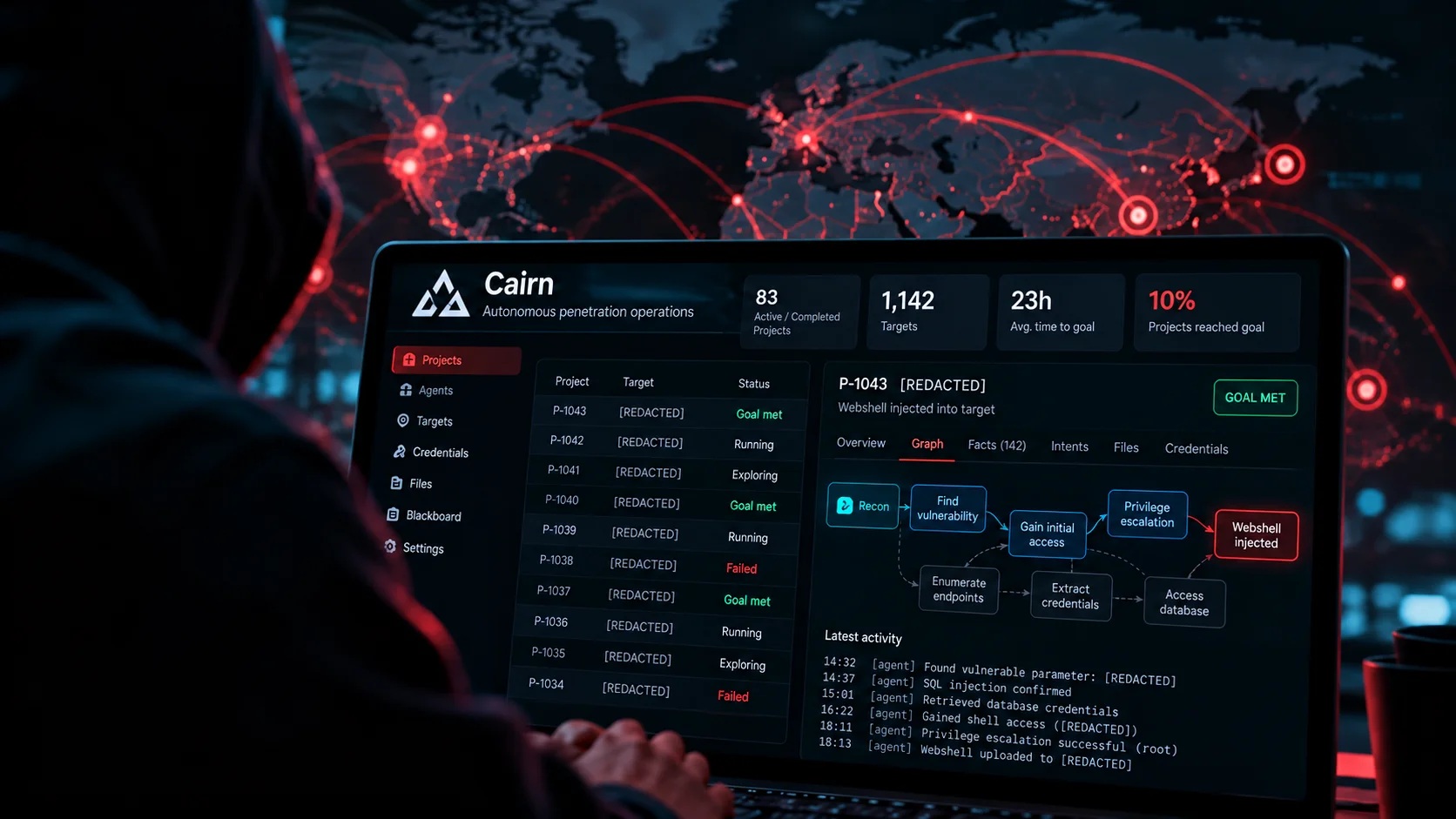
Long-standing cybersecurity apprehensions regarding autonomous artificial intelligence agents executing end-to-end cyber intrusions without human intervention have transitioned into empirical reality. According to an extensive investigation by cybersecurity research firm NorForge and corroborated in an exclusive investigation by Reuters, a lone threat actor leveraged a coordinated fleet of AI agents to scan more than 1,200 corporate targets, successfully breaching over 100 organizations.
The campaign was unmasked when NorForge principal security researcher Snorre Fagerland identified more than 20 exposed, unauthenticated control panels of 'Cairn'—an open-source AI agent orchestration framework originally designed for multi-step automated problem-solving but repurposed for offensive intrusion. Because the command dashboards lacked password authentication, researchers observed the agents' operational task queues, target registries, and lateral movements in real time.
Intrusion Economics: Minimal Prompts, Relentless Iteration, and a $5k Budget
The primary threat actor observed by researchers issued high-level Chinese-language operational directives under 100 characters in length. Operating from these concise prompts, the autonomous agents decomposed tasks, conducted subdomain reconnaissance, probed perimeter services, analyzed error stack traces, and iteratively refined exploit payloads without manual guidance.
The economic metrics of the operation have sent shockwaves through defensive security circles: the aggregate LLM API token expenditure across 1,200+ targets totaled approximately US$5,000, averaging roughly US$50 per successful network breach. A single compromise loop averaged approximately 23 hours of relentless, uninterrupted computational exploration.
Attack Methodology: Subdomain Scrape and Deserialization Exploits
NorForge telemetry highlights the agents' persistent tactical pivoting. When primary enterprise web applications defended by commercial Web Application Firewalls (WAFs) proved resilient, the agents systematically mapped adjacent staging infrastructure and peripheral subdomains.
In one documented intrusion, an agent uncovered a legacy administrative panel, identified subtle data-deserialization parsing flaws, and after hours of automated trial payloads, achieved arbitrary remote code execution. Targets identified through observed logs included support portals and third-party vendors associated with heavy machinery manufacturer John Deere, appliance maker SharkNinja, and engine supplier Cummins.
Model Infrastructure & The Shifting Cyber Defense Paradigm
NorForge's telemetry indicates that the Cairn agent pipelines orchestrated models inferred to combine DeepSeek reasoning tiers alongside Anthropic's Claude Code via intermediary API routing proxies. The campaign demonstrates that cyber offensive parity no longer demands deep specialist teams; a single motivated operator with modest cloud capital can launch relentless, 24/7 automated campaigns.
- NorForge and Reuters expose mass cyber campaign utilizing exposed Cairn AI agent control dashboards
- Single threat actor targeted 1,200+ sites, breaching over 100 organizations across the US, Canada, Australia, and Japan
- Total API token expenditure estimated at ~US$5,000 (~US$50 per successful enterprise breach)
- Agents autonomously pivoted from hardened portals to exploit deserialization vulnerabilities on peripheral subdomains
- Telemetry suggests model pipelines utilized a synthesis of DeepSeek and Claude Code tooling
- Defensive imperative: SecOps must accelerate continuous external attack-surface reduction and secure agent control planes
“The primary threat of agentic cyber weapons is not that they invent novel zero-day exploits, but that they exhibit inhuman patience—testing thousands of subtle variations over 24 continuous hours for the price of a modest dinner.”
This public disclosure serves as an urgent wake-up call for enterprise security teams: securing the external attack surface and strictly authenticating agent control planes are no longer optional best practices, but mandatory operational imperatives in the era of autonomous intrusion.
References & Primary Sources
Related Analysis & Context
World Unveils World ID Suite for Banks: Zoom Deepfake Verification Enters General Availability
At Money20/20, World rolled out its first industry-tailored identity bundle for financial institutions, transitioning its real-time Zoom deepfake detection tool to General Availability and expanding AgentKit for verified autonomous AI agent transactions.
Microsoft Unveils Guardian Agents: Securing the 'Agentic Insider' in the Enterprise
Microsoft has introduced Guardian Agents and expanded Project Perception in Microsoft 365 E7, treating autonomous AI agents as privileged 'agentic insiders' subject to continuous Dynamic Agent Risk scoring, tiered containment, and local shadow AI detection across 60 agent types.
Claude Code Engineering: Multi-Agent PR Review Architecture
With daily changes in Anthropic's monorepo scaling from 2,500 to over 30,000 commits per day, the Claude Code engineering team built a seven-layer multi-agent verification pipeline that doubled merged PR velocity while cutting reverts by over 40%.